

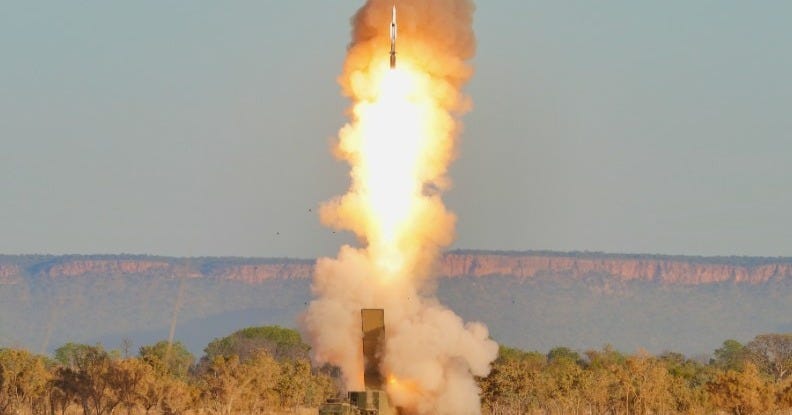
Last September, the U.S. flew its Typhon launchers out of Japan when the drill ended. This year, they stay.
The U.S. Army’s Typhon Mid-Range Capability (MRC) missile system arrives at Japan Maritime Self-Defense Force Kanoya Air Base in Kagoshima today as Valiant Shield 2026 kicks off — but unlike the 2025 deployment to Marine Corps Air Station Iwakuni, the launchers are not being airlifted home when the exercise wraps. Valiant Shield runs through July 1. Orient Shield follows in September. From mid-October, the MRC relocates to a U.S. military base inside Japan for storage. Translation: a Tomahawk-capable ground launcher now lives on Japanese soil.
Watching the hands, not the headlines.
Kanoya sits at the southern tip of Kyushu, on the First Island Chain, with the Ryukyu arc immediately south and the waters north of Taiwan within easy strike reach. The Typhon fires Tomahawk cruise missiles out to roughly 1,600 km, plus SM-6 interceptors. From Kanoya, the East China Sea, the Taiwan Strait, and a deep stretch of the Chinese coast all sit inside the envelope. Japan now becomes the second U.S. ally inside the First Island Chain to host a persistent Typhon presence — after the Philippines, where the launchers arrived in 2024 and never left.
Beijing heard it. China’s foreign ministry has condemned the deployment, branding Typhon “a strategic offensive weapon” that endangers regional security. The same script ran in 2024 against Manila. It didn’t work then. It won’t work now. On May 5, the U.S. Army fired a live Tomahawk from a Typhon at Tacloban Airport, hitting a target roughly 600 km away on Luzon. Proof of concept, then proof of range, now proof of permanence.
Washington exited the Intermediate-Range Nuclear Forces (INF) Treaty in 2019. Beijing was never bound by it and spent two decades stacking ground-based mid-range missiles across the theater. The alliance is now closing the gap — at the choke point, on the front line, with Tokyo as the willing host.
The stall game just ran out.
ACI — Aric Chen | Insights