

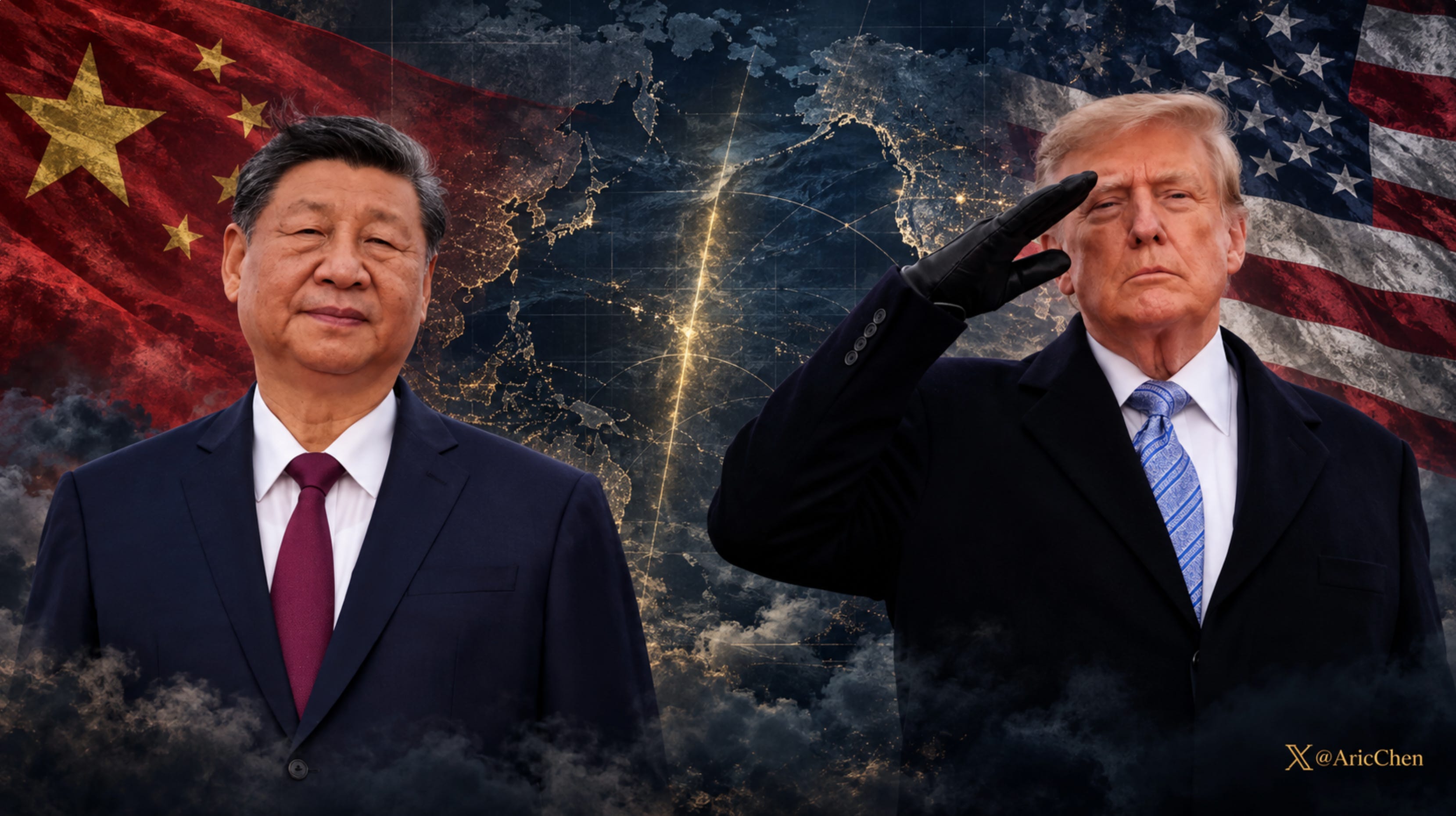
On Wednesday night at Joint Base Andrews, America did something it almost never does. The President of the United States walked onto the tarmac, stood at the foot of a foreign aircraft, and personally received the general secretary of the Chinese Communist Party. Red carpet. Honor guard. Anthems. Flyover. The cameras loved it. Beijing will replay it until the pixels peel off.
Do not be fooled by the theater. This was not America kneeling. It was America choosing the terrain.
For decades, U.S. presidents have reserved that kind of airport reception for the rarest of guests. The last time a sitting American president went to the tarmac for a hostile power’s ruler, the world was still measuring distance in megatons. Eisenhower met Khrushchev in 1959 because nuclear catastrophe was not an abstraction. Protocol is a tool. Great powers use it when the alternative is drift, miscalculation, or a two-front squeeze they cannot afford. That is the correct way to read Wednesday night.
Xi Jinping is not a normal head of state. He is an unelected, repressive dictator who rules by fear at home and by coercion abroad. He jails dissenters, erases whole peoples, and treats “rule of law” as a slogan for export only. He is building the fastest military expansion in modern Chinese history while turning the world’s second-largest economy into a weapons system: supply chains, rare earths, critical minerals, and political warfare. That is not a partner. That is a rival that wants to occupy its neighbors and rewrite the map. Every minute of Thursday’s talks should start from that fact.
Washington already knows it. Treasury Secretary Scott Bessent spent the week grinding through unfinished business with He Lifeng because “stability” without reciprocity is just another word for American concession. Secretary of State Marco Rubio said the quiet part in public: this is the world’s second-largest economy, with a rapidly expanding military, and the United States has severe friction with it on trade, supply chains, and critical minerals. Talking to that regime is not romance. It is statecraft. You do not have to like the man on the other side of the table to decide that unmanaged collision is worse than managed pressure.
Look at the board, not the handshake.
First, strategic cooling with the principal rival. The Chinese Communist Party’s method is to keep every theater hot at once: the Taiwan Strait, the South China Sea, economic coercion, transnational repression, and proxy leverage in the Middle East. A president who creates even a temporary corridor of predictability is not “soft on China.” He is denying Beijing the gift of American distraction.
Second, agriculture is not a footnote. It is a lever. Beijing’s purchase pledges on soybeans and other farm goods have been late, partial, and political. Forcing the Party to buy American harvests is not charity to Midwestern counties. It is a reminder that the regime still needs access to a market it cannot replace, and that American producers should not be the first casualties of a dictatorship’s games. Ahead of a midterm year, that is also competent politics. A country that cannot feed its own politics cannot sustain a long contest.
Third, time is a weapon. The United States has other fires. Energy chokepoints around the Strait of Hormuz and the Bab el-Mandeb still sit on the world’s oil throat. When a war in that region threatens a huge share of global crude flows, the intelligent move is not to pretend China is a bystander. Beijing is the patron, the buyer, the diplomatic shield, and the industrial backstop. If you want the smaller war contained, you deal with the larger sponsor. That is not “far alliance, near attack” as a slogan from a textbook. It is the oldest logic in strategy: freeze the distant giant long enough to settle the nearer knife.
None of this requires amnesia about what the Party is doing while the limos roll. Peaceful protests have already been cleared near the White House to tell Xi to stop crushing dissent inside China and to stop hunting critics outside it. Transnational repression is not a human-rights sidebar. It is an attack on sovereignty. A regime that intimidates people on American streets is advertising that it does not recognize borders, only power.
And Taiwan is not on the table. Anyone selling the fantasy that Washington will trade the island for a smile and a commodity pledge does not understand American interests. Taiwan is not a sentiment. It is the world’s most important advanced-chip foundry and the geographic lock on the first island chain. The Strait is not a Chinese lake. It is a corridor of U.S. economic security, technological security, and homeland security. You do not pawn the lock because the burglar arrived in a motorcade.
So what did the tarmac actually say?
It said: we see you. We know the military buildup. We know the mineral chokehold. We know the malice that American families are already paying for in prices, supply shocks, and stolen technology. We will still meet you, on our ground, with our ceremony, under our guns on the flight line, because a serious country does not outsource its calendar to a Party that mistakes pageantry for victory.
Beijing will call this respect. It is closer to containment with manners. The red carpet is short. The agenda is long. The dictator can have the photograph. America should keep the strategy: reciprocity or nothing, Taiwan untraded, time bought, and the Chinese Communist Party treated as what it is, not a guest of honor, but the principal problem of this century.
ACI — Aric Chen | Insights