

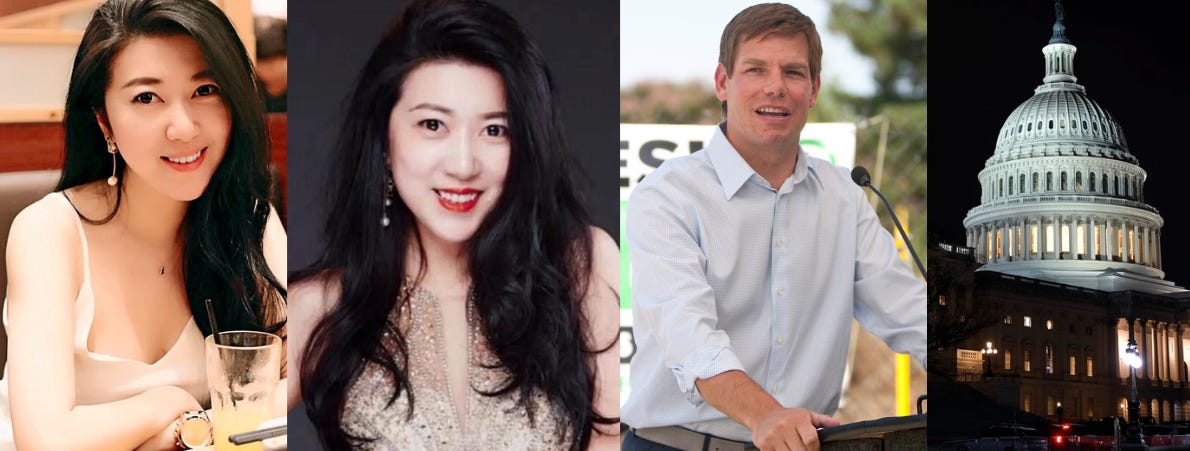
About this series. Nine Files is nine pieces on the women who have worked for Chinese intelligence and united front organs inside democracies, from the Shanghai underground of the 1930s to a NATO internship that ended in an arrest last month. I went through roughly thirty prosecutions and official findings across eight countries. The thing the genre promises, the honeytrap, turns out to be the mechanism in exactly two of them. The rest run on money, on positions inside government, on manufactured identities, on debt, and on patience. Part one is the Christine Fang file, declassified this month. Ahead: a sitting president of the UN General Assembly on a monthly retainer, a mayor whose birth certificate was invented, a Taiwanese general and the four incompatible accounts of how he was turned, and the women the Party destroyed after they had served it. One part is about people who were accused and were innocent, because a series that leaves them out is not worth reading. Part one of nine.
“Served as flight attendant on Air Force One for the President of People’s Republic of China.”
That line sits near the top of a résumé Christine Fang submitted in 2013. The company she was applying to did not exist. An FBI undercover agent had built it, and the contract she signed that June asked her to carry out political tasks and provide what the paperwork called cultural expertise.
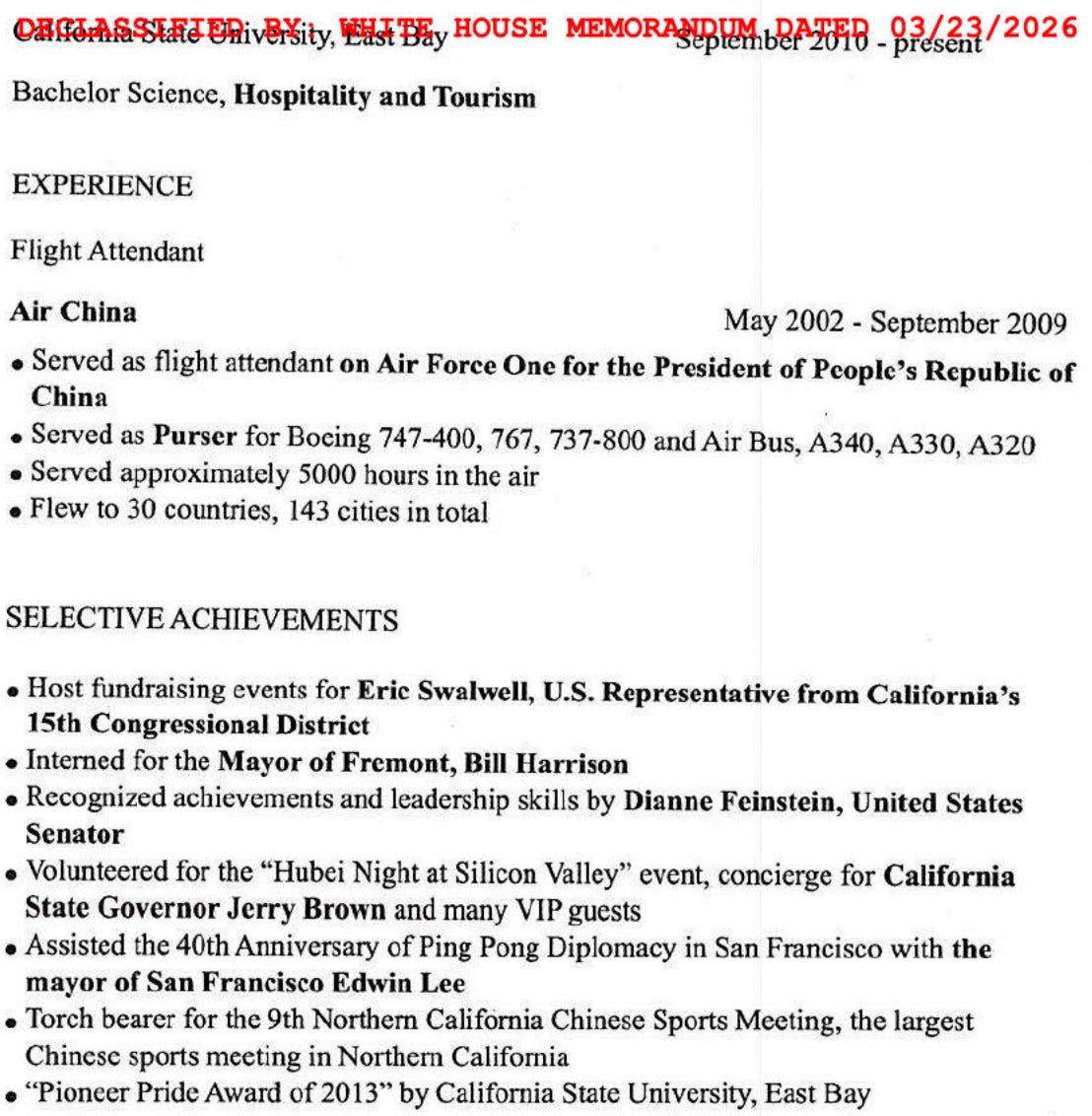
Under the Air China years, May 2002 to September 2009, purser on 747s and A340s, five thousand hours in the air, thirty countries, a hundred and forty-three cities, came a section she headed Selective Achievements. Fundraising events hosted for Eric Swalwell, U.S. Representative from California’s 15th Congressional District. An internship with the mayor of Fremont. Recognition from Senator Dianne Feinstein. Concierge for Governor Jerry Brown at an evening called Hubei Night at Silicon Valley. Assisting the fortieth anniversary of Ping Pong Diplomacy in San Francisco with Mayor Ed Lee.
Five thousand hours is a long time to spend in a trade whose whole craft is anticipating what an important stranger wants before he asks, and making him feel remembered afterwards. She had done seven years of it.
She was applying for a job. She was also advertising a network.
The company had a purpose. By 2013 the Bureau had assessed that Fang was connected to the Ministry of State Security, and it opened an effort, code-named Rusty Thumbs, to run her as a double agent without her realising she was working for the United States. The job offer was the hook. It lasted until evidence came in that she was actively steering campaign donations and hiring decisions, at which point the recruitment was shut down and the matter turned into a criminal investigation. The résumé is what fell out of that first phase. It exists because she thought she was being hired.
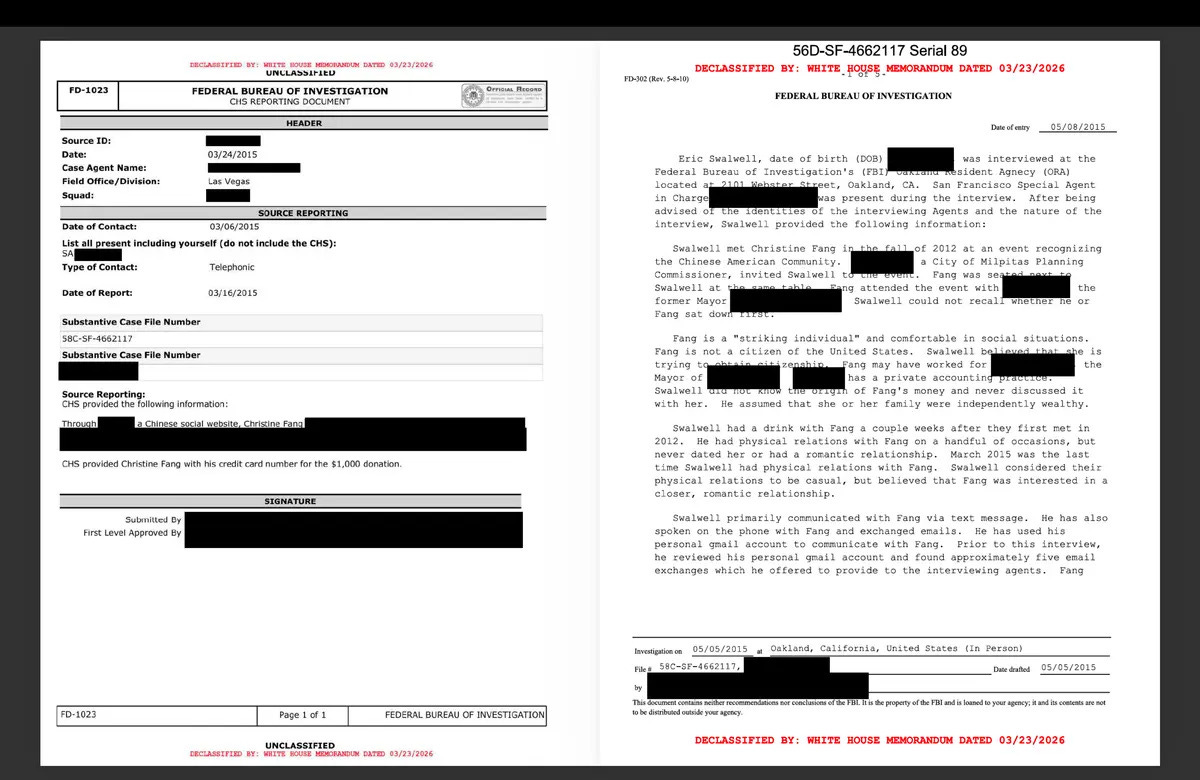
Nearly 150 pages of FBI material on Fang went public on 17 August, and the coverage has gone almost entirely to one line in it: Swalwell’s admission, made to agents in 2015 and 2016, that he had physical relations with her on a handful of occasions. One of those nights she turned up at his apartment unannounced. He had taken Ambien before she arrived and told agents he barely remembers the evening.
Sit with that for a second, because it is a fair measure of what the sex was worth to the operation. He cannot remember it. The interns she placed were still in the building years later. That is the story the word honeytrap was invented for, and it is the least interesting thing in the file.
This is the first of nine pieces, one mechanism at a time. The rest of the run is set out at the top, and the cases get stranger as they go.
Here is what working through them did to my assumptions.
I looked at roughly thirty prosecutions and official findings, across the United States, Britain, Japan, the Philippines, Australia, Germany, France and Taiwan, running from the Shanghai underground of the 1930s to a NATO internship in Belgium that ended in an arrest last month. In two of them sex is the actual mechanism. Two. A Japanese cipher clerk in Shanghai in 2004, and a French intelligence officer recalled from Beijing over an affair with the ambassador’s interpreter, a woman he later married. Everything else runs on other machinery entirely: declared political donations, forged birth certificates, air cargo manifests, intern placements, temple pilgrimage networks, cryptocurrency, underground money exchanged through jewellery shops, and, in a New York indictment that ended in a hung jury last December, six Nanjing salted ducks delivered by a Chinese official’s personal chef to the parents of a governor’s former deputy chief of staff.
The honeytrap is the cliché. The spreadsheet is the reality.
Two things convinced me the cliché is worth attacking rather than just ignoring.
The first is that Beijing itself publishes the honeytrap as something done to China. In May this year the Ministry of State Security put out a public warning to Chinese citizens with access to secrets, describing foreign intelligence officers who construct a “perfect persona,” the rich and beautiful woman, the tall and handsome man, who appear at academic conferences and business events, build intimacy through high-frequency contact, and then use what they have on you. There is a companion version aimed at women. Read the ministry’s own material and the seduction always arrives from outside. That is a self-serving frame, obviously. It is also a reminder that the doctrine Western readers assume exists in Chinese intelligence writing is, in the published record, entirely defensive.
The second is a small matter of dates that I think ends the argument. English-language commentary loves to explain Chinese intelligence through the Thirty-Six Stratagems, whose thirty-first is the beauty trap. No significant Chinese bibliography records that book before the modern era. The version everyone quotes comes from a manuscript found in Shaanxi in 1941 and printed in Chengdu on cheap wartime paper. The Chinese Communist Party’s Central Special Branch, its first professional intelligence organ, was founded in Shanghai in 1927. The book was not in print yet.
The serious analysts have been saying a version of this for years, in language careful enough that nobody quotes it. Peter Mattis, testifying to the US-China Economic and Security Review Commission in 2016, put sexual entrapment among those elements of Chinese operational aggressiveness that had “risen and then faded.” MI5’s 2008 threat assessment, circulated to hundreds of British firms, said Chinese services were known to “exploit vulnerabilities such as sexual relationships and illegal activities to pressurize individuals to cooperate.” Exploit an existing weakness. Not deploy a woman to create one. Those are different trades, and the difference is the whole subject.
So what was Fang actually doing.
She enrolled at California State University, East Bay in 2011 and made herself president of the campus Chinese Student Association and president of the campus chapter of APAPA, the Asian Pacific Islander American Public Affairs Association. She collected a school pride award. She raised money. She bundled for Swalwell’s 2014 re-election, volunteered on Ro Khanna’s unsuccessful 2014 congressional run, and helped put together a 2013 fundraiser for Tulsi Gabbard. Federal Election Commission records show no donations in her own name, because a Chinese national cannot legally give a cent. Money reached Swalwell’s campaign through American conduits instead, twice in 2013 and twice in 2014. In March 2015 an FBI source gave Fang a credit card number and a thousand dollars went into the same campaign. The form that records it, an FD-1023 dated 24 March 2015, sits in the released material with most of its body blacked out. What survives the redaction is the card, the amount and her name. Investigators had a title for the campaign finance side of the case. They called it Operation Freshman Fifteen.
Freshman. That word is the thesis of this entire series, and it was chosen by American counterintelligence, not by me.
Then the interns. Fang referred people into Swalwell’s campaign organisation and into his congressional office, presented as candidates coming through APAPA, which made them look like every other well-connected community referral on Capitol Hill. Swalwell has confirmed the referrals and says he took them at face value.
The Bureau’s own summary of what it thought was happening is in the released memos, and it is worth reading twice: “Investigation has revealed Fang ‘Christine’ Fang, a Chinese foreign national residing in the United States, is the facilitator of a scheme to trade access to Swalwell and internships in his congressional office in return for campaign contributions.”
Read that carefully and the internships are not the by-product. They are the currency. Investigators believed the positions themselves were being traded, which means somebody had worked out that a desk in a congressional office has a market price. No secret changes hands in that sentence. Nothing in it requires a bedroom either.
Not everyone around her was fooled, and it changed nothing. One of the donors was a wealthy winery owner. Her pitch to him, according to the files, was that he should just bring his checkbook, because she would reimburse him afterwards. That is a straw donation scheme described in six words, by the person running it, to a man who was not even a hard sell. The Epoch Times, working from the same interview summary, reports that he also told agents he had sometimes thought Fang was a Chinese spy. The money went in under his name regardless.
Now the parts that a careful reader is entitled to hold against all of the above.
Fang has never been charged with a crime, in the United States or anywhere else. Swalwell has never been charged either. He told the FBI she never asked him for classified information and that he never provided any, and no investigator has produced evidence of classified material moving; he was dropped as a subject of the investigation in 2017. His lawyers describe the release of the files as a smear. He resigned from Congress in April this year over an unrelated matter. The most lurid material in the public record, the relationships with two Midwestern mayors, one of them introducing her at a Washington conference in 2014 as his girlfriend, comes from unnamed officials quoted by Axios in December 2020, and I would not put it in a book without saying so every time.
Take all of that at face value. Grant every denial. The operation still worked exactly as designed, because the design never required a secret.
Bill Harrison, the Fremont mayor whose office appears on that résumé, described later what the FBI had told him about the method. Their words, as he recalled them: to strike up a relationship with you and see if you move up the line.
A congressional intern is twenty-two years old. She sits below the level where anyone runs a serious background investigation, and she is perhaps eight years from running a member’s legislative operation. In 2013 a freshman congressman from the East Bay had nothing worth stealing. What he had was a trajectory. Christine Fang was not buying secrets. She was buying a position inside a career that had not happened yet, at a price of a few thousand dollars, some fundraising labour and a great deal of patience.
The FBI director said the same thing in public in January 2022, in a speech at the Reagan Library, and almost nobody picked it up: they look to cultivate talent early, often state and local officials, to ensure that politicians at all levels of government will be ready to take a call. Christopher Wray also said, in the same speech, that the threat is the Chinese government and the Chinese Communist Party, not the Chinese people and certainly not Chinese Americans, who are themselves frequently victims of it. Both halves of that belong in any honest account, and the fourth piece in this series is about what happens when the second half is forgotten.
Fang flew home to China in May 2015, after agents interviewed her and searched her Bay Area apartment. She cancelled a Washington event she had spent months arranging and told people she had to leave at once. Gilbert Wong, the former Cupertino mayor, gave the best description of the exit: she disappeared off the face of everything. The five-year window for charging those 2014 conduit donations closed in 2019.
What she left behind is the document I started with. A woman applying for a job at a company that was not real, listing the American politicians she had reached as professional accomplishments, in the same section as her flight hours.
Officials handling this month’s release say they are now examining whether interns were placed the same way into other federal and state offices. I want to see those résumés.
Next, part two: a sitting president of the United Nations General Assembly, and the woman who put him on a monthly retainer.
ACI — Aric Chen | Insights
© 2026 Aric Chen. All rights reserved. Any unauthorized use will be reported under the DMCA.