

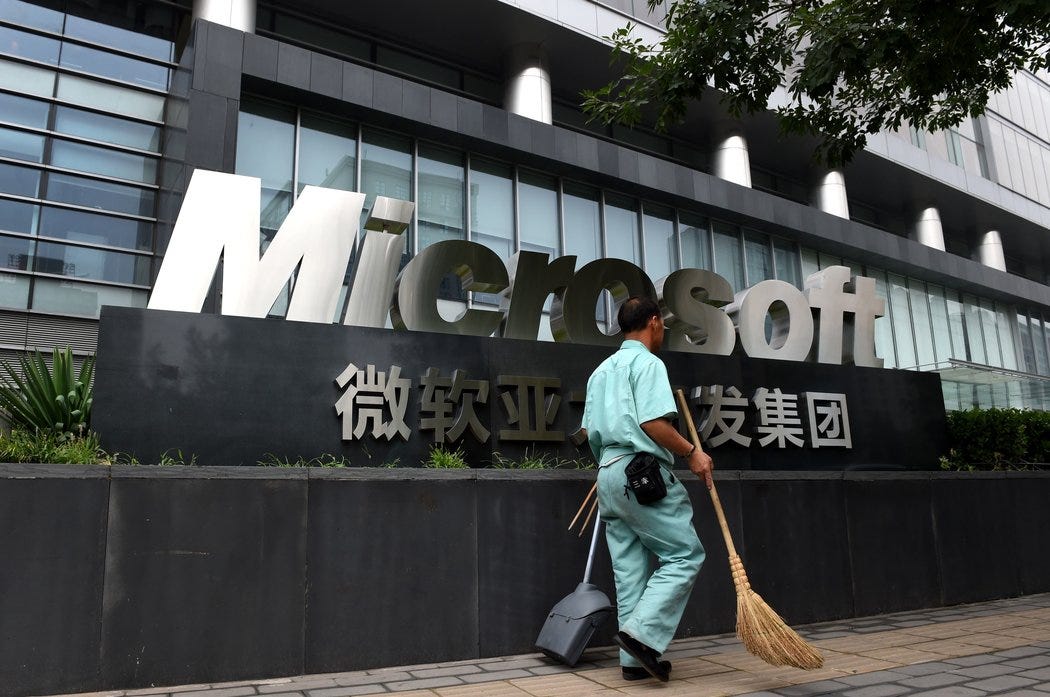
Microsoft’s largest artificial intelligence customer in China is ByteDance, and most of what ByteDance buys is access to OpenAI models running on Azure for workloads that sit outside China. Reuters puts the run rate at more than a billion dollars a year. Hold that number, because it is close to the whole reason Microsoft is still in the market.
Everything built around it has been coming down for five years. Corporate filings reviewed by Reuters show at least 15 Microsoft branch offices and joint ventures in China have shut since 2021. Wicresoft, the joint venture Microsoft set up with the Shanghai city government in 2002 and the first it ever had in the country, halted its China projects in April 2025, and roughly 2,000 people lost their jobs. Microsoft closed its authorised physical retail presence on the mainland in 2024. LinkedIn, which Microsoft owns, withdrew its main platform from China in 2021 and shut InCareer, the stripped-down job board it left behind, in August 2023. Around June this year came another 200 to 400 Azure cuts in China, the third such round in two years. Five company sources told Reuters that Microsoft debated leaving altogether in 2023, having concluded it was carrying serious geopolitical exposure in return for about 1.5% of global revenue, the share Brad Smith gave Congress under questioning in June 2024. Microsoft’s stated position is that it “remains committed to the Chinese market” and “has no current plans to exit.”
That is a retreat by any reading. The mechanism interests me more than the tally, because Beijing never expelled anyone. No licence was revoked. There was no press conference.
Beijing wrote procurement rules instead
From 2017 the state pushed “safe and reliable” domestic software through government procurement guidance, and foreign operating systems were not certified as compliant. In September 2022 the State-owned Assets Supervision and Administration Commission issued Document 79. Liza Lin reported for the Wall Street Journal in March 2024 that it orders state-owned enterprises in finance, energy and other core sectors to strip foreign software out of their IT systems by 2027, and that the order was held so closely that officials were shown the paper and forbidden to copy it. The full text has never been published, and the version that is public says nothing about removing foreign software, which is worth stating plainly rather than leaving for a critic to point out. Inside the industry it picked up a nickname regardless: Delete A, for Delete America.
The results sit in the paperwork. Reuters reviewed six Chinese government computer-system procurement guides published between December 2023 and May 2026. Five do not recommend Microsoft at all. The sixth permits Windows 10 China Government Edition, and attaches “additional management requirements” to using it.
That sixth guide is where this gets uncomfortable, because Windows 10 China Government Edition was not imposed on Microsoft. Microsoft built it. It shipped in May 2017 through CMIT, a joint venture with China Electronics Technology Group, the state-owned defence electronics conglomerate. The product handed Chinese government users their own update control and the ability to embed their own encryption algorithms. China Customs, the Shanghai city government and a state-owned enterprise were the pilot customers.
Bing tells a similar story. It has been the one Western search engine Beijing allowed to keep operating on the mainland, and it stayed by censoring. Citizen Lab at the University of Toronto reported in 2024 that Bing’s filtering inside China ran in places ahead of what Baidu and Tencent applied, blocking translation results outright when they mentioned Xi Jinping.
So the compliance was thorough. A bespoke operating system for the state, built with a state defence partner. A search engine filtered to Beijing’s satisfaction. And seven years before that, when Google pulled out over censorship and the hacking of its systems, Steve Ballmer said Google was overreacting.
Microsoft gave Beijing what Beijing asked for, and Beijing shut it out of the government market regardless. Any executive still modelling China as a normal market with political noise layered on top should sit with that sequence for a moment. Compliance was never going to buy permanence, because a better-behaved foreign supplier was not the objective. A domestic supplier was.
What Beijing has not replaced yet
Washington’s controls on advanced chips drew a firm boundary around what Microsoft could sell into China, which is exactly what they were built to do. Microsoft has been moving its research centre of gravity to match, applying for visas to relocate AI researchers out of Microsoft Research Asia in Beijing and standing up aligned labs in Vancouver, Singapore and Tokyo. That transition has been slower than the org chart suggests. Reuters reported that when Microsoft offered relocation to around 1,000 of its top engineers in 2024, only about a third took it, with senior people preferring Chinese universities and domestic firms where they could keep doing frontier work near their families.
What survives commercially is the piece Beijing has not been able to substitute. ByteDance and SHEIN both run global workloads on Azure. What they are buying is Western AI for use outside China, along with data handling that foreign regulators will accept, which is not something a purely domestic stack can deliver for them today.
So Microsoft’s China business has quietly stopped being a business in China. It has become an export facility, a way for Chinese firms to operate abroad on American models.
That is a narrower and more fragile position than the headline revenue implies, and it rests on two conditions. The first is that Chinese frontier models are not yet good enough for ByteDance’s overseas products. Beijing is spending heavily to end that condition and has been explicit about the timeline. The second is that Chinese companies selling into Europe and the United States need infrastructure their regulators will tolerate, and that one is harder for Beijing to engineer away, because it depends on decisions made in Brussels and Washington rather than in Beijing.
If you want to know how much time Microsoft has left in China, watch the ByteDance relationship, not the office count. The closures are a lagging indicator of a decision Beijing took in 2017.
ACI — Aric Chen | Insights