

On the morning of March 22, 2024, a 26-year-old Chinese dissident named Ling Huazhan was being herded toward the boarding gates of Terminal 1 at Paris-Charles de Gaulle airport by seven people. Two of them worked for the Chinese embassy. A China Southern Airlines A350 to Guangzhou was on the schedule at 11:35 a.m. Ling had been told he was at the airport to collect his confiscated passport. He was not. He was being put on a one-way flight back to the People’s Republic of China.
The plan failed. France’s border police, the DNPAF, intervened in the final minutes and pulled Ling out of the operation. What they did not yet know was that they had just unraveled a thread that, two years later, would lead France’s domestic intelligence service to dismantle one of the most extensive Chinese clandestine policing networks ever exposed on European soil.

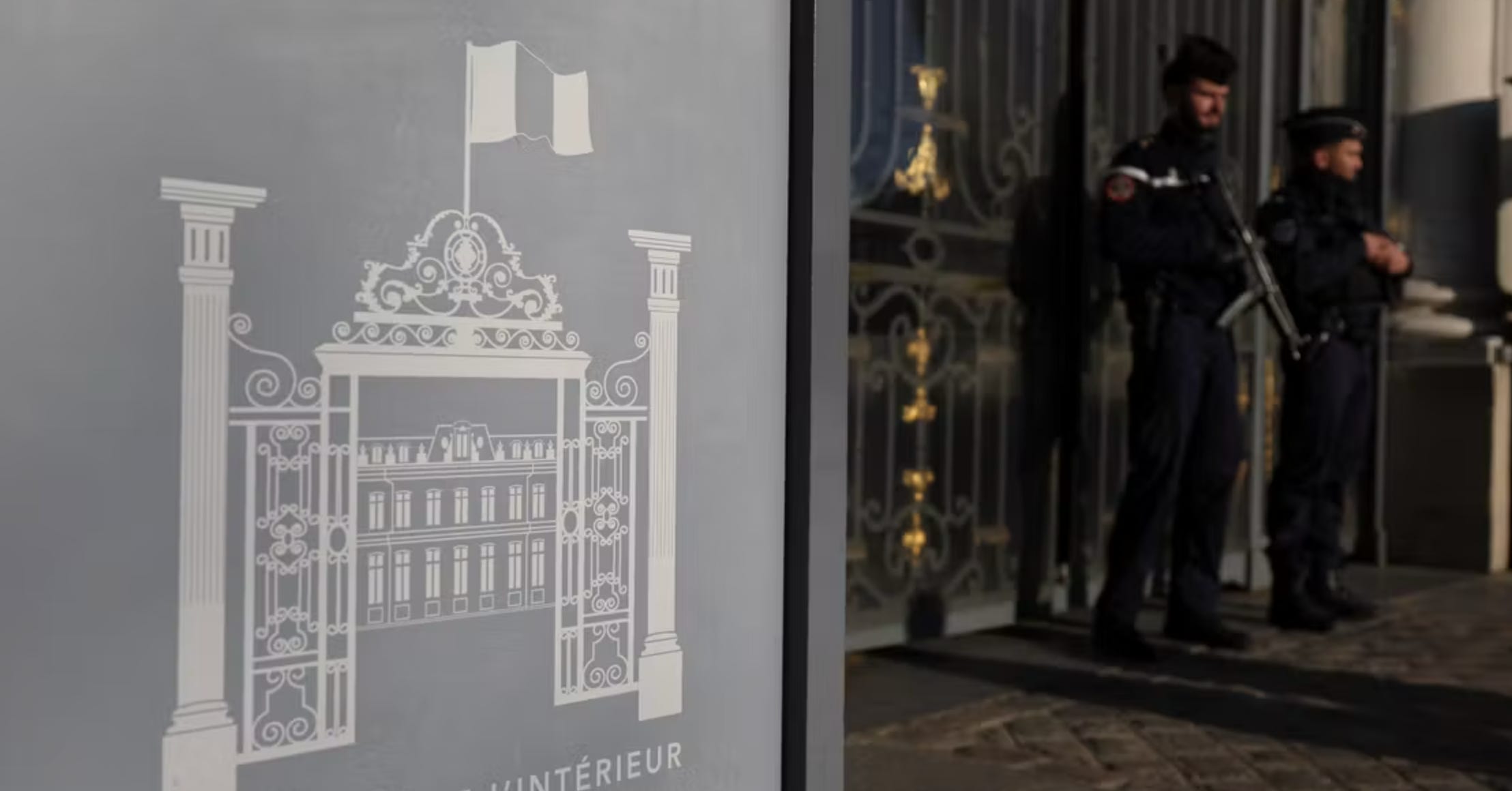
This month, Paris-based daily Le Monde — citing France’s Interior Ministry and judicial investigation files — confirmed that the Direction Générale de la Sécurité Intérieure (DGSI), France’s domestic intelligence agency, has shut down nine clandestine “police stations” operating in France on behalf of China’s Ministry of Public Security (MPS). The closures followed a year-long investigation that began in early 2025 and were finalized in early 2026.
According to the Interior Ministry, three of the station “chiefs” — all Chinese nationals — have been issued expulsion orders. Two have already been removed from French territory. The third, whose case had stalled on appeal, faced his decisive hearing on June 9, 2026, when the public rapporteur before the joined 2nd and 7th chambers of the Conseil d’État, France’s highest administrative court, recommended that the expulsion be upheld.
The Fujian Front
The third man is identified in French press reports as Ni Chaowen, 57. He arrived in France in 2001, secured legal status only in 2012, and built a string of low-margin garment, leather goods, and jewelry firms in the Paris region. Since 2023 he has served as president of the Fédération Franco-Chinoise du Fujian — the France Fujian Chamber of Commerce — a community business association that, on paper, exists to promote trade ties.
Inside that chamber, according to French government filings, Ni was running a parallel structure: an unregistered satellite of the Chinese Ministry of Public Security. French police reportedly recovered a photograph of him standing in front of a sign bearing the words “Fuzhou Overseas Police Service Station” — the very signage Beijing has used to brand its network of so-called “overseas 110” outposts.
This is not a marginal detail. Fujian provincial public security bureaus — Fuzhou, Wenzhou, Qingtian, Nantong — have been the operational backbone of the global “overseas police station” network since at least 2016. Where the network has been forensically dismantled, in New York and now in Paris, the structure has been the same: a hometown or business association, a local Chinese-national fixer with deep ties back to Fujian, and a remote handler at a provincial Ministry of Public Security bureau in China.
The Legal Architecture That Powers It
What allows Beijing to run a foreign intelligence apparatus through low-profile shopkeepers and association chairs is not a clandestine recruitment program. It is, in large part, written law.
On June 28, 2017, the People’s Republic of China enacted its National Intelligence Law, which obligates Chinese citizens and Chinese entities — wherever they are in the world — to “support, assist and cooperate with state intelligence work” under the framework of the United Front. As Le Monde noted in its reporting, the practical effect is that any Chinese national living abroad can be tasked, on demand, by Chinese security organs. The diaspora becomes a recruiting pool by statute, not by accident.
This is also why the current French expulsions matter in a way that the 2024 wave did not, or at least not in the same form. In 2024, after the Charles de Gaulle incident, France expelled the head of the Chinese Ministry of State Security (MSS) post in Paris and his deputy — both had been operating under diplomatic cover. Those expulsions targeted the formal espionage apparatus. The 2026 expulsions reach below that — into the network of Chinese nationals without diplomatic immunity who were running the day-to-day work of surveillance and coercion. It is the layer Beijing always counted on to be invisible.
A European Pattern, Not a French Anomaly
The Spain-based NGO Safeguard Defenders first mapped this network in its 2022 report, identifying more than 100 such outposts across at least 53 countries on five continents. Initial French exposure was four stations. The figure has now more than doubled.
Across Europe, the response has accelerated. The Netherlands, Spain, the United Kingdom, Ireland and Germany have all opened investigations or ordered closures. In the United States, federal juries have begun convicting operators. In May 2026, Lu Jianwang, the former president of the America ChangLe Association in New York, was found guilty in Brooklyn federal court of acting as an unregistered foreign agent for the Chinese Ministry of Public Security and obstructing justice by deleting WeChat communications with his MPS handler in Fuzhou. The U.S. Department of Justice has separately charged dozens of MPS officers in absentia for transnational repression targeting U.S. residents.
Beijing’s standard response, repeated in every jurisdiction, is that these stations are benign service centers helping overseas Chinese renew driver’s licenses or process paperwork — a story it leaned on heavily during the COVID-19 travel restrictions. The Chinese embassy in Paris similarly denounced Le Monde‘s 2024 reporting on the Ling case as “fabricated.” The evidentiary record in New York, the diplomatic expulsions in Paris, and now the nine confirmed closures in France make that cover story increasingly difficult to sustain.
What This Was Really For
The Ministry of Public Security’s overseas network sits inside a broader Chinese Communist Party (CCP) campaign that Beijing itself markets domestically as Operation Fox Hunt and “Sky Net”. Officially, these are anti-corruption programs to recover fugitives. In practice — as the U.S. Department of Justice, Safeguard Defenders, the FBI, and now French counterintelligence have all documented — the same infrastructure is used against political dissidents, ethnic and religious minorities, former officials who fell out of favor, and entrepreneurs whose assets Beijing wants repatriated. The instrument is what Chinese authorities euphemistically call “persuasion to return”: pressure on family members still inside China, threats to property, refusal to renew documents, and, when those fail, the kind of operation Ling Huazhan walked into a Charles de Gaulle.
In its briefings to French legislators, the DGSI has warned that closing the physical stations does not close the operation. The same proxies continue to work through cultural associations, chambers of commerce, hometown federations, and informal networks tied to provincial public security bureaus back in China. The signage is gone. The infrastructure is not.
The Wider Lesson
The French case is a clarifying one. It demonstrates, with court filings and a public rapporteur’s recommendation, what civil society researchers have been arguing for years: that the CCP runs an institutionalized program of transnational repression on the soil of democratic allies, that it does so by weaponizing diaspora associations and exploiting its own domestic intelligence statutes, and that the program is durable enough to survive the closure of its visible nodes.
For governments across the Indo-Pacific and the Atlantic that have signed cooperation agreements with the Chinese Ministry of Public Security — including Canada under its January 2026 strategic partnership with Beijing — Paris’s findings should be read closely. The same ministry that ran Ni Chaowen ran Lu Jianwang. The same statute that obligated them obligates every Chinese national working in every host country today.
Beijing heard Paris. The next test is which capital is willing to listen to what Paris has just said out loud.
ACI — Aric Chen | Insights