

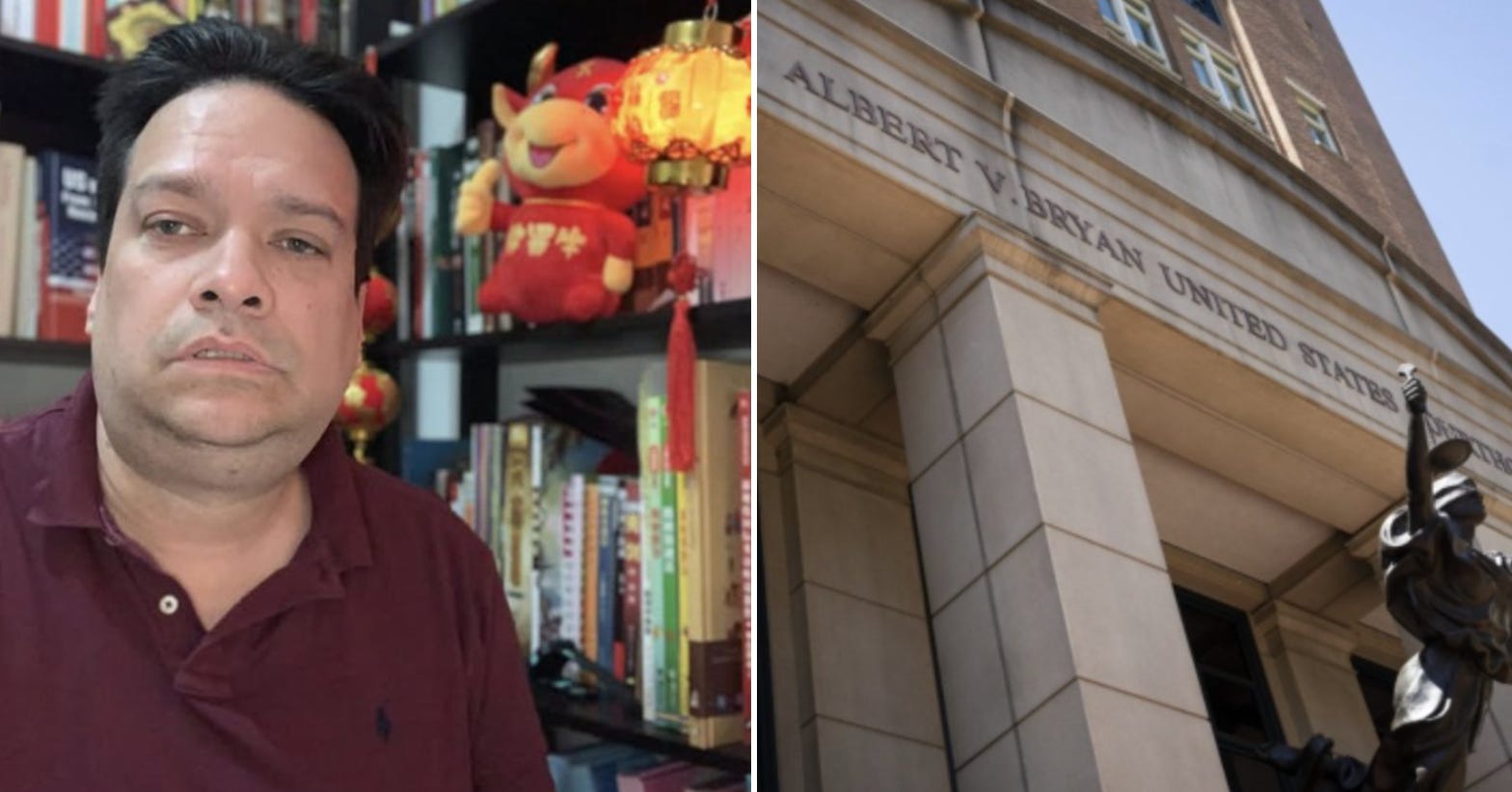
In a federal courthouse in Alexandria, Virginia on Thursday, a U.S. citizen named Thomas Weir Pauken II stood up in forest-green prison clothing and admitted what he had spent years denying: he was not a journalist who happened to find Beijing’s worldview persuasive. He was a paid asset of the Chinese Ministry of State Security (MSS), Beijing’s principal civilian intelligence service.
His handler, identified in court documents only as “Cathy,” paid him at least $100,000 over the course of the operation. Cathy told Pauken that some of his reports were being read by Xi Jinping personally. Whether that was literally true or operational flattery is, in a sense, beside the point. Pauken believed it, and worked accordingly.
This is the most consequential CCP espionage guilty plea of 2026 to date, and it deserves a much wider audience than it has so far received. So let me lay it out the way a senior intelligence analyst would.
How the operation actually ran
Per the Justice Department filing and supporting court documents, Pauken operated under MSS direction from at least 2019 through February of this year. Cathy’s taskings followed a consistent pattern: identify Americans with access to sensitive information, befriend them, hand them devices (laptops, cellphones) that would route their communications back to her, and produce written or recorded interviews built around questions Cathy supplied. After each transmission, Pauken was instructed to delete the message thread. He and his sources were then paid.
In January 2025, on Cathy’s instructions, Pauken flew from China to Washington carrying $3,000 in cash and a cellphone meant for an individual identified in court documents only as “Person 1,” a Virginia resident currently employed by a U.S. government agency. Cathy’s reported written instruction to him: “Tom, you will be the one to convince him to provide classified information.”
He pleaded guilty before Judge Leonie Brinkema, who warned that any further contact with foreign intelligence services would bring “serious consequences.” Sentencing is scheduled for September 1. The statutory maximum is ten years.
The pedigree that made him useful
Pauken is not a marginal figure. His father, Thomas Pauken Sr., served in the Reagan administration and chaired the Texas Republican Party. The younger Pauken used the alias “Tom McGregor” in China to wall his media activity off from the family name. In retrospect, that wall looks less like a privacy preference and more like operational hygiene.
He relocated to Hong Kong around 2010 and worked his way through the CCP propaganda apparatus: China Radio International, then China Central Television, then CGTN (Beijing’s English-language flagship), and finally an editor’s position at Xinhua starting in 2024. On the side, he hosted programming for Guancha (观察者网), the Shanghai-based nationalist outlet that functions as an intellectual hype platform for Xi-era ideology. In 2022 he publicly defended Beijing against Western human-rights boycotts of the Winter Olympics, deploying the now-familiar deflection that “no country is perfect.” On Quora in 2021, he wrote that critics described Beijing in “evil terms” when in reality the regime was simply “very unique” and “refused to take orders.” Guancha picked that one up and ran with it.
This is precisely the demographic Beijing prizes: a U.S. passport, an American family name, a recognizable conservative-establishment lineage, all fronting Chinese state messaging in English. When Western audiences saw Pauken on CGTN, they thought they were seeing a Western analyst who had simply found Beijing’s case more compelling than the West’s. They were watching an MSS asset.
Cathy was not his only handler
The Justice Department filing names two other men, “Richard” and “William,” whom Pauken met in 2017. They told him the reports he wrote for them were destined for Japan. Pauken himself, the filing says, believed they worked for the PRC government. The Japan cover story was almost certainly that: cover.
He also sold reports to a Wuhan-based group that wanted information on U.S. technology and on the U.S. Department of Justice itself. That group, prosecutors say, asked Pauken to help them locate a cyber espionage expert.
In plain language: while one MSS line was running Pauken against U.S. government personnel in Virginia, a parallel Wuhan line was using the same person as a recruiting channel for offensive cyber capability. That is not freelancing. That is compartmentalized tradecraft, which is what professional services do.
What this case actually exposes
Two observations for the allied intelligence community across and beyond the Indo-Pacific, both of which Beijing would prefer no one focus on.
The first is that CCP state media is not a parallel ecosystem from CCP intelligence. It is the same ecosystem with different signage on the door. The MSS recruits from inside CGTN, CRI and Xinhua because that is where the useful Western faces already are: credentialed, English-fluent, embedded, presentable. Anyone who has spent more than a decade inside that machine should, by default, be a person of interest to Western counterintelligence services, with the burden of proof on the individual.
The second is that the MSS targeting set has moved well beyond the standard academic-and-think-tank profile. The Pauken case adds a confirmed FBI-prosecuted instance of an MSS attempt to convert a sitting U.S. federal employee, on U.S. soil, into a classified-information source, with the cash and the burner phone already across the Pacific. This was not a probing operation. This was a recruitment operation that reached the delivery stage and was interrupted by U.S. Customs and Border Protection, not by any failure on Beijing’s part.
Pauken’s lawyer issued a statement on his behalf urging “all Americans working internationally” to keep the Foreign Agents Registration Act and related federal statutes in mind. That is the legal framing.
The political framing is simpler. The CCP ran an American citizen for at least seven years, paid him six figures, walked him into the country with cash and a burner phone intended for a U.S. federal employee, and ran a parallel cyber-recruitment line through him at the same time. The Justice Department and the FBI caught one. The next is already out there. The democracies’ job is to make sure the next one is caught earlier.
Aric’s Note: This commentary is independent editorial analysis based on public Department of Justice filings, FBI statements, and court documents from the U.S. District Court for the Eastern District of Virginia. Sentencing is scheduled for September 1, 2026. Quotations are drawn from the publicly available plea agreement and DOJ press release.
Original analysis by @aricchen. Views are my own — welcome to discuss!
© 2026 Aric Chen